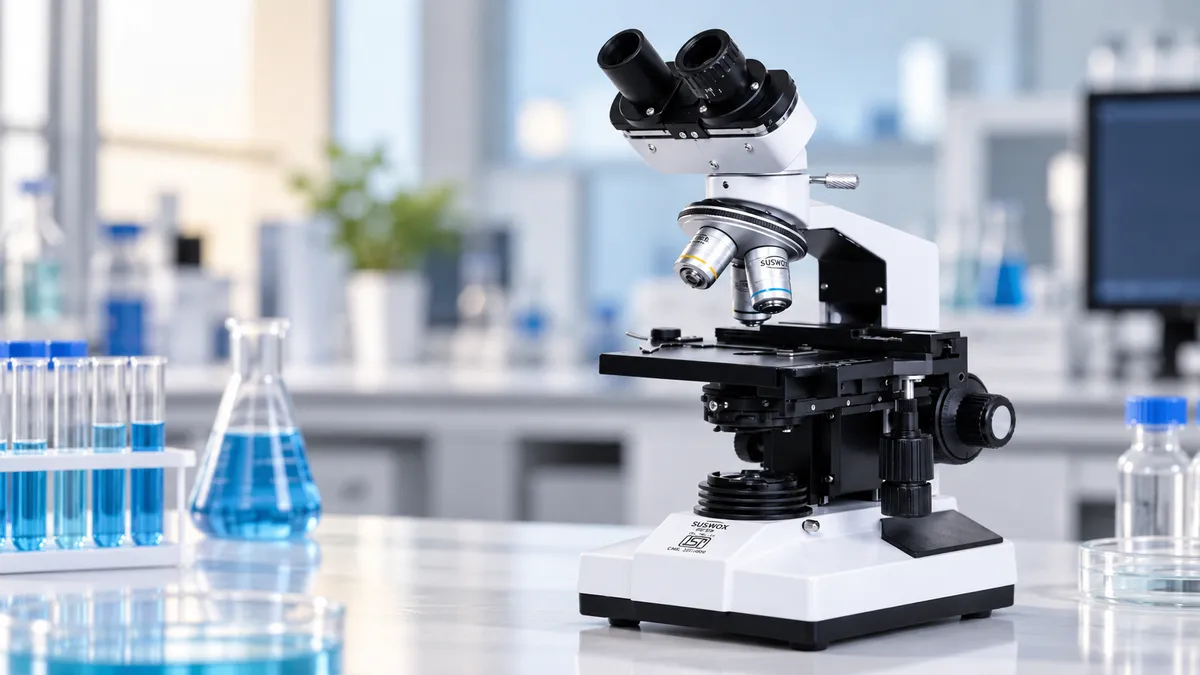
Ask anyone who buys lab equipment in India where their microscopes come from, and there is a good chance the answer is Ambala.
This city in Haryana is not huge. It is better known to most people as a railway junction or an army cantonment. But in the world of scientific instruments, Ambala has a reputation that goes well beyond its size. A large share of the microscopes used in Indian schools, colleges and labs are made here.
So how did a mid-sized town in Haryana end up at the centre of India's microscope industry?
Ambala has been making microscopes and lab instruments for decades
Alt text: Microscopes made in Ambala used in a laboratory | Image link: https://suswox.com/wp-content/uploads/2026/07/suswox-banner-1.webp
After Independence, India needed scientific equipment for its new schools, universities and hospitals. Importing everything was costly. Small workshops in Ambala began making simple lab instruments to fill the gap.
Over time these workshops grew. Skills were passed from fathers to sons, and from master craftsmen to apprentices. Families who started with a single bench went on to run full factories. The know-how stayed in the city, and so did the industry.
Today Ambala has a whole network built around scientific instruments: lens grinders, metal casting units, machinists, painters, packers and testing setups. A microscope maker here can source most of what it needs within a few kilometres.
Grinding and fitting optical parts is careful work. It takes years to learn. In Ambala, many workers have been doing it their whole lives, and many learned it at home.
Because so many instrument makers sit close together, suppliers of parts and raw material are always nearby. This keeps costs down and delivery times short.
With dozens of makers in the same city, nobody can afford to sell poor products for long. Buyers can compare easily, and the good makers earn repeat orders.
Many Ambala makers have years of experience with government and institutional buying. They understand ISI marking, tender paperwork and GeM listings, which makes life easier for purchase departments.
An ISI-marked trinocular lab microscope made in Ambala
Alt text: SC-300 Ti trinocular microscope made in Ambala, Haryana | Image link: https://suswox.com/wp-content/uploads/2024/07/suswox-trinocular-microscope-isi-marked-sc300ti-600x901.webp
Ambala is home to many microscope brands. Some of the most familiar ones include:
Each has its own strengths. Some focus on schools, some on research labs, some on industrial use.
SUSWOX is a good example of how Ambala makers have grown. The company started in 1973 under Sudheer Scientific Works. More than fifty years later, it makes student microscopes, lab and pathology models, research microscopes, stereo zoom microscopes, inverted microscopes and digital imaging systems, all from its own unit in Ambala.
Their lab microscopes are ISI marked. Their clients include AIIMS Nagpur, AIIMS Bathinda, AIIMS Bilaspur, BHU, Kurukshetra University and the Haffkine Institute. They also export to buyers outside India.
If you are comparing microscope manufacturers in Ambala, SUSWOX is worth adding to your shortlist.
If you plan to buy microscopes from an Ambala maker, keep these points in mind:
Ambala's story is a quiet success. Without much noise, the city has become one of the most important places in India for scientific instruments, and microscopes are at the heart of that.
For buyers, this means real choice, fair prices and makers with decades of experience. Brands like SUSWOX show what that experience looks like when it is applied to every instrument that leaves the factory.